Pujya Pad Jagadguru Swami
Shri Rambhadracharya Ji Maharaj
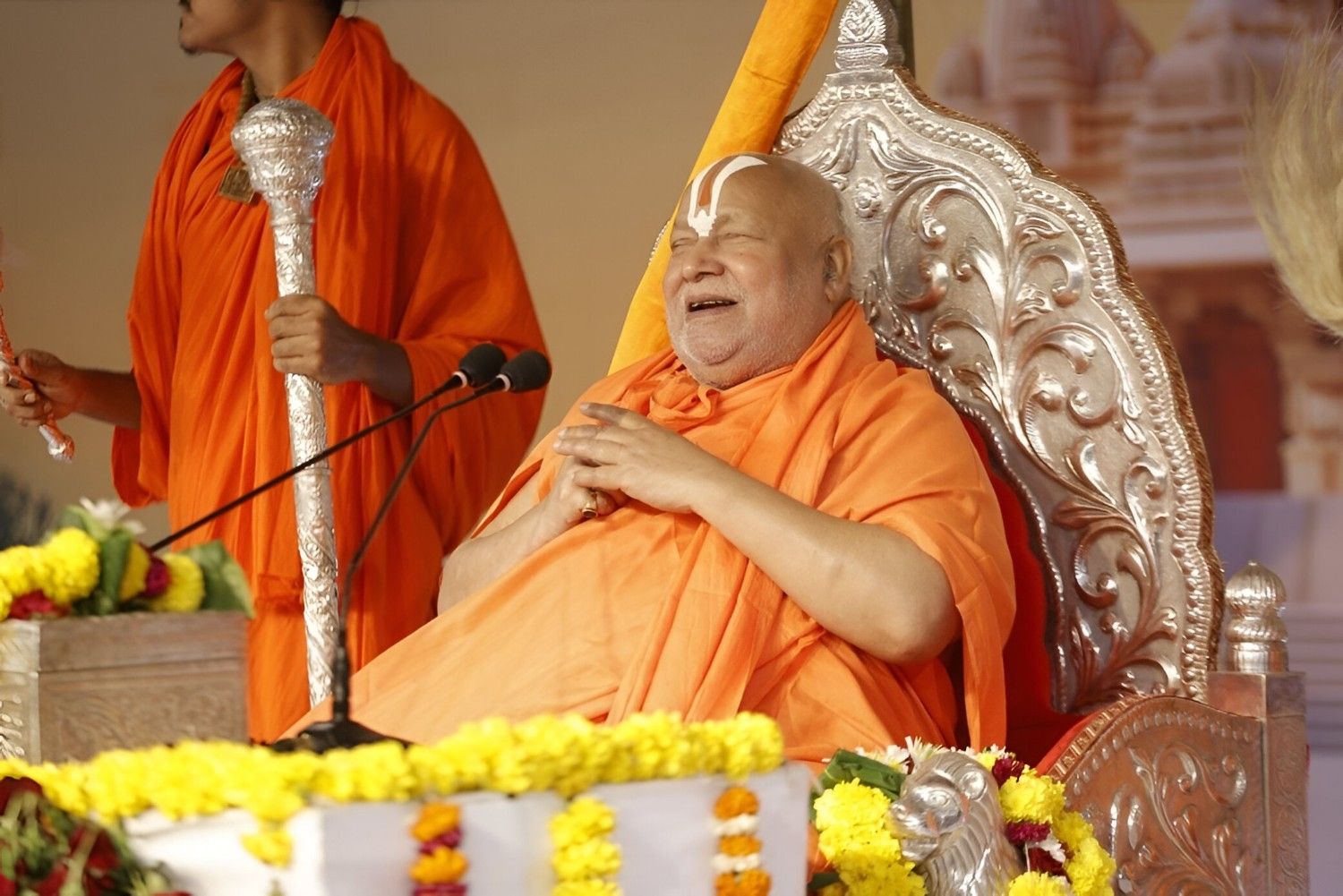
Early Life
Birth
Pujya Pad Jagadguru Swami Shri Rambhadracharya Ji Maharaj was born into a devout Saryupareen Brahmin family of Vashishtha Gotra in Shandikhurd village, Jaunpur district, Uttar Pradesh, India. He was born on January 14, 1950, during the auspicious festival of Makar Sankranti (Magha Krishna Ekadashi, Vikram Samvat 2006). His parents were mother Shachi Devi Mishra and father Pandit Rajdev Mishra. He was named Giridhar Ji, a name of Lord Krishna, by a cousin of his paternal grandfather, who was a devotee of Mirabai.
Protection of Sanatana Dharma
The entire life of Pujya Pad Jagadguru Swami Shri Rambhadracharya Ji Maharaj is dedicated to the protection, preservation, and propagation of Sanatana Dharma. He continuously shares the teachings and principles of Sanatana Dharma, Indian culture, and spiritual values with people throughout the world.
Spiritual Guidance to Society
Through his spiritual discourses, divine teachings, and Shri Ram Katha, Pujya Gurudev guides society and inspires people to follow the path of Dharma, uphold Indian culture, and live by the values of truth and righteousness. His guidance goes beyond religious knowledge, encouraging individuals to develop good character, strong moral values, and spiritual awareness in their daily lives.
Teachings of Lord Shri Ram and Hanuman Ji
Pujya Gurudev shares the ideals of Lord Shri Ram, including righteousness, selfless service, devotion, and exemplary conduct. Through Shri Ram Katha and the inspiring life of Hanuman Ji, he encourages people to deepen their devotion to Lord Shri Ram and embrace a life of dedication, humility, faith, and selfless service, following the example of Hanuman Ji.
Values and Life Lessons
Through his life and teachings, Pujya Gurudev encourages everyone to respect elders, treat all people with kindness and respect, pursue education and knowledge, speak the truth, and follow the righteous path. His wisdom, deep scholarship, spiritual discipline, and constant devotion to Shri Ram inspire people to remain patient in difficult situations and face life's challenges with faith, courage, and determination.
Inspiration and Legacy
His life continues to be a source of pride, inspiration, and spiritual guidance for people everywhere. By following his thoughts, teachings, and ideals, we can strengthen the values of Dharma, truth, service, and goodwill, while contributing to a more virtuous and harmonious society.
Initial Education
Giridhar Ji began his early education at home under the guidance of his grandfather, Pandit Suryabali Mishra. Blessed with an exceptional memory, he memorized the entire Bhagavad Gita in Sanskrit, including its chapter and verse numbers, by the age of five. By the age of eight, with his grandfather's guidance, he had memorized the Ramcharitmanas composed by Saint Tulsidas. He later studied and mastered the Vedas, Upanishads, Bhagavata Purana, major works of Sanskrit grammar, and the literary works of the poet-saint Tulsidas.
His Upanayana Sanskar was performed on June 24, 1961, on the auspicious occasion of Nirjala Ekadashi. During the ceremony, he received the Gayatri Mantra and was initiated into the Ram Mantra by Pandit Ishwardas Maharaj of Ayodhya.
Higher Education
In 1966, Giridhar Ji joined Adarsh Gaurishankar Sanskrit Mahavidyalaya in Jaunpur, where he studied Sanskrit grammar and other subjects for five years. Known for his remarkable Ekashruta ability to remember what he heard after listening just once, he consistently excelled in his studies and topped his class throughout this period. In 1971, he enrolled at Sampurnanand Sanskrit Vishwavidyalaya in Varanasi to pursue higher studies.
In 1973, Giridhar Ji travelled to New Delhi to participate in national-level Sanskrit competitions at the Akhil Bharatiya Sanskrit Adhiveshan. He won five gold medals in Vyakaran, Sankhya, Nyaya, Vedanta, and Antyakshari. Impressed by his exceptional scholarship, Prime Minister Indira Gandhi offered to arrange treatment for his eyes in the United States, but he respectfully declined the offer.
In 1973 and 1976, respectively, Giridhar Ji earned the Shastri (Bachelor's) and Acharya (Master's) degrees in Vyakaran from Sampurnanand Sanskrit Vishwavidyalaya, receiving gold medals for both examinations. In recognition of his broad academic knowledge, he was declared Acharya in all subjects taught at the university. Under the guidance of Pandit Ramprasad Tripathi, he completed his doctoral Vidyavaridhi degree (PhD) in 1981 from the same university. His Sanskrit dissertation, Adhyatmaramayane Apaniniyaprayoganam Vimarshah, examined non-Paninian usages in the Adhyatma Ramayana.
In 1997, Giridhar Ji received the postdoctoral Vachaspati degree (DLitt) from the same university. His Sanskrit dissertation, Ashtadhyayyah Pratisutram Shabdabodhasamikshanam, presented an explanation of the grammar of Ashtadhyayi through clear and accessible Sanskrit verses.
Life after Virakta Diksha
Tulsi Peeth
Swami Shri Rambhadracharya Ji Maharaj has remained a lifelong Brahmachari, observing Viravrata, the vow of spiritual discipline. On November 19, 1983, the auspicious day of Kartik Purnima, he received Vairagi initiation (Virakta Diksha) into the Ramanand Sampradaya. In accordance with the tradition, he was given the Vaishnava name Rambhadradas, meaning a servant of Lord Ram. In 1987, he established Tulsi Peeth in Chitrakoot, a sacred place associated with Lord Shri Ram's fourteen-year exile. As its founder, he was honoured by saints and scholars with the title Shri Chitrakoot Tulsi Peethadhishwar.
Jagadguru
Jagadguru is a Sanskrit term meaning "teacher of the world." In Sanatana Dharma, the title is associated with spiritual teachers who possess profound knowledge of Vedic scriptures. Traditionally, it has been conferred upon Vedanta Acharyas who composed Sanskrit commentaries on the three principal texts of Vedanta, collectively known as the Prasthanatrayi: the Brahma Sutra, the Bhagavad Gita, and the principal Upanishads. Six prominent Acharyas traditionally associated with this title are Shankaracharya, Nimbarkacharya, Ramanujacharya, Madhvacharya, Ramanandacharya, and Vallabhacharya. According to the original account, the tradition of composing Sanskrit commentaries on the Prasthanatrayi declined for approximately five centuries after Vallabhacharya.
Jagadguru Ramanandacharya established the Ramanand Sampradaya and composed the Anandabhashya, a commentary on the Prasthanatrayi. The tradition reveres him as an incarnation of Lord Shri Ram in the age of Kali.
। रामानन्दः स्वयं रामः प्रादुर्भूतो महीतले ।
Successors in the Ramanandacharya tradition receive the title Jagadguru Ramanandacharya. Swami Rambhadradas Ji was selected for this position in 1989 and was ceremonially anointed in Ayodhya on August 1, 1995. He subsequently composed Sanskrit commentaries titled Shriraghavakripabhashya on the Brahma Sutra, the Bhagavad Gita, and eleven Upanishads. Through these scholarly works, Swami Shri Rambhadracharya Ji Maharaj contributed to the revival of the Jagadguru tradition and presented another interpretation of Vedanta within the Ramanand Sampradaya, following the Anandabhashya.
The Grace of Saraswati
From an early age, Giridhar Ji demonstrated a remarkable gift for composing poetry in Prakrit and Sanskrit. While learning from his grandfather, he would spontaneously compose verses expressing his thoughts and feelings on various subjects. Throughout his life, Jagadguru Swami Shri Rambhadracharya Ji Maharaj has demonstrated proficiency in 22 languages and is renowned as an accomplished poet and spontaneous composer (Ashukavi) in several Indian languages. He has authored more than 80 major literary works, along with numerous shorter compositions. His notable contributions include four epic poems, commentaries on the Prasthanatrayi, Ashtadhyayi, and Ramcharitmanas, as well as a critical edition of the Ramcharitmanas.
A University Dedicated to Persons with Disabilities
Having personally experienced the challenges faced by persons with disabilities, Jagadguru Swami Shri Rambhadracharya Ji Maharaj dedicated himself to creating better educational opportunities for them. After establishing primary and secondary educational institutions for students with disabilities, he founded Pujya Pad Jagadguru Swami Shri Rambhadracharya Ji Maharaj Divyang University in Chitrakoot in 2002. He continues to serve as the university's lifelong Chancellor, guiding its educational vision and commitment to inclusive learning.
The university offers undergraduate and postgraduate courses in Sanskrit, Hindi, English, Sociology, Psychology, Music, Drawing and Painting, Fine Arts, Special Education, Education, History, Culture and Archaeology, Computer and Information Sciences, Vocational Education, Law, Economics, and Prosthetics and Orthotics. It provides education at nominal fees to eligible students with visual, hearing, and mobility disabilities, supporting their access to higher education. Jagadguru Swami Shri Rambhadracharya Ji Maharaj continues to guide the university's development and day-to-day functioning.
Deposition on Behalf of Lord Ram in the Ayodhya Case
In 2003, Jagadguru Swami Shri Rambhadracharya Ji Maharaj appeared as an expert witness on religious matters before the Allahabad High Court. Since Lord Ram, represented as an infant in the case, was a minor, Jagadguru Ji presented his testimony in support of the religious claims concerning the birthplace of Lord Ram. His affidavit and portions of his cross-examination were cited in the High Court's final judgment.
In his affidavit, Jagadguru Ji referred to ancient Hindu scriptures, including Valmiki's Ramayana, the Ramatapaniya Upanishad, the Skanda Purana, the Yajurveda, and the Atharvaveda, which describe Ayodhya's religious significance and its association with the birthplace of Lord Ram. He also cited verses from two works of Goswami Tulsidas Ji: eight verses from the Doha Shataka concerning the disputed site's history and one verse from the Kavitavali referring to the site. Addressing the argument that the original temple stood north of the disputed area, he explained the boundaries of Ram Janmabhoomi as described in the Ayodhya Mahatmya section of the Skanda Purana. These boundaries were noted as corresponding with the disputed location by Justice Sudhir Agarwal. The judgment delivered on September 30, 2010, addressed the claims concerning the site, and Jagadguru Ji's testimony became a notable part of the legal proceedings.
Critical Edition of the Ramcharitmanas
The Ramcharitmanas, composed by Goswami Tulsidas Ji in the late sixteenth century, contains approximately 10,800 verses and has remained one of the most revered literary works in northern India for more than four centuries. Over time, numerous editions have been published, including those from Venkatesh Press, Khemraj Prakashan, Gita Press, Motilal Banarsidass, Kaudorama, Rameshvara Bhatta, Jvalaprasad, Kapurthala, and Patna. Several commentaries have also been written, including Manaspiyush, Manasgoodharthachandrika, Manas-mayank, Vinayaki, Vijaya, and Balabodhini. Differences exist among these editions in verse counts, textual readings, spelling, and grammar. Some editions, including the Motilal Banarsidass edition, also include an additional eighth Kanda as a supplement.
During the twentieth century, critical editions of the Mahabharata and Valmiki's Ramayana were published by institutions such as the Bhandarkar Oriental Research Institute and Maharaja Sayajirao University. However, a comparable critical edition of the Ramcharitmanas had not been prepared. Having recited the complete Ramcharitmanas more than 4,000 times since childhood, Swami Shri Rambhadracharya Ji Maharaj undertook this extensive scholarly work. Over eight years of research, he studied approximately fifty different editions to prepare a critical edition known as the Tulsi Peeth edition, which was published in 2006. The Raghava Parivar regards this edition as preserving the exact wording of Goswami Tulsidas Ji's original composition.
Saint of Our Times
Saint, scholar, commentator, poet, visionary, spiritual leader, orator, singer, educationist, and social reformer — Jagadguru Swami Shri Rambhadracharya Ji Maharaj embodies countless qualities. His life and work also stand as an inspiration to persons with disabilities. As the Sanskrit expression नेति नेति reminds us — “not this, not this” — no description can fully capture his remarkable personality and contributions. He is truly a revered saint of our times, and we are privileged to witness his life and spiritual presence.
॥ परोपकाराय सतां विभूतयः ॥
The virtues and gifts of saints exist for the welfare of others. — Sanskrit maxim
1008-Kundiya Shri Hanuman Yagna and Shree Ram Katha bookings
To know about upcoming kathas, spiritual events, and programmes, call or message us.